
Live streaming is supposed to happen in real time. Yet anyone who has operated an international broadcasting network knows that delivering video across thousands of kilometres can be surprisingly complicated.
A powerful server, a fast internet connection and professional streaming software do not automatically guarantee low latency.
We recently worked on an international broadcasting project that demonstrated exactly why.
The customer operated a network of entertainment venues in Southeast Asia, distributing live video across multiple locations. The original streaming infrastructure was functioning, but there was one serious problem: viewers were receiving the video approximately 75 seconds after the original broadcast.
For certain applications, such a delay might be acceptable. For live entertainment and synchronised broadcasts across multiple venues, however, it can create operational difficulties.
The project required more than simply upgrading hardware. It involved reviewing the streaming architecture, improving delivery performance and adjusting the way video moved between different parts of the network.
Following the optimisation work, the customer eventually reported approximately six seconds of end-to-end latency.
This is the story of that improvement and what other broadcasters can learn from it.
The Challenge: Broadcasting Across Multiple Locations
The customer needed to distribute live video reliably to a growing network of venues in Thailand.
Each location required consistent playback, and the infrastructure had to accommodate multiple simultaneous streams.
The system also needed to serve audiences across different geographical regions.
This presented several challenges.
First, the original infrastructure introduced substantial delay between the live source and the viewer.
Second, distributing video internationally required careful consideration of network routing and server locations.
Third, the system needed sufficient capacity to handle traffic fluctuations without compromising playback stability.
The solution involved using dedicated streaming servers as part of a geographically distributed broadcasting architecture, rather than depending on a single general-purpose hosting environment.
Dedicated infrastructure provides greater control over processing resources, streaming applications and network configuration. However, the real performance gains depend on how these components work together.
Why Was the Original Streaming Delay So High?
Live streaming latency is not caused by one single factor.
Delay accumulates at different stages of the broadcasting process.
For example, a typical live streaming workflow includes:
- Video capture and encoding at the source.
- Transmission to the streaming ingest server.
- Processing and packaging into a delivery format.
- Distribution through the origin server or CDN.
- Buffering and playback on the viewer’s device.
Every stage can introduce additional latency.
Traditional HTTP Live Streaming (HLS) configurations may use relatively long media segments and several segments of player buffering.
If the player waits for multiple segments before beginning playback, the accumulated delay can become significant.
Network conditions, encoder settings and streaming software configuration can add further delays.
In our customer’s case, the approximately 75-second delay was the starting point for a broader investigation.
It would be misleading to attribute the entire delay to a single setting. The system had to be evaluated as a complete delivery chain.
The Infrastructure: Singapore and the United States
One important part of the project involved dedicated server infrastructure in two geographical regions.
Singapore provided a strategic location for receiving streams originating in Southeast Asia.
A second dedicated server in the United States supported the broader international streaming architecture.
This arrangement allowed the system to separate parts of the broadcasting workflow and provide infrastructure closer to different network regions.
The general architecture can be represented as follows:
Live Video Sources in Thailand
↓
Singapore Dedicated Streaming Infrastructure
↓
International Streaming Distribution
↓
United States Dedicated Streaming Infrastructure / CDN Delivery
↓
Viewers and Remote Locations
This is a simplified conceptual diagram. Actual traffic paths can differ depending on the viewer’s location and the configured distribution workflow.
The objective was not simply to move streams between two powerful machines.
It was to establish a reliable delivery architecture in which the different components could communicate efficiently and maintain consistent playback.
Why Server Location Matters
The physical distance between a broadcaster and a streaming server affects network latency.
A stream originating in Thailand may reach a server in Singapore more efficiently than one located much farther away.
However, geographical proximity is not the only factor.
Internet routing, network congestion, packet loss and the quality of connections between providers can influence performance.
A server in a nearby country does not necessarily provide better results if its network routing is inefficient.
Similarly, adding more servers does not automatically reduce end-to-end streaming delay.
The architecture must be designed around the actual sources, viewers and delivery requirements.
In this project, the Singapore and United States infrastructure formed part of a broader approach to improving reliability and distribution.
From 75 Seconds to 15 Seconds
The first major improvement came through changes to the streaming delivery configuration and infrastructure.
After the initial optimisation work, observed latency fell from approximately 75 seconds to around 15 seconds.
This was already a substantial improvement.
| Performance stage | Approximate latency | Reduction from original |
|---|---|---|
| Original streaming configuration | 75 seconds | — |
| After initial optimisation | 15 seconds | 80% |
| Final result reported by customer | 6 seconds | 92% |
The final six-second figure was reported by the customer following further optimisation. It should be understood as a customer-observed result rather than an independently benchmarked measurement across every device and viewing location.
Nevertheless, the progression illustrates how much difference an appropriately designed streaming system can make.
A reduction from 75 seconds to six seconds represents approximately 92% less delay.
The Role of RTMP and HLS
Two technologies were particularly relevant to the streaming workflow: RTMP and HLS.
RTMP is widely used for transmitting live video from broadcasting software to an ingest server.
Applications such as OBS Studio and professional encoders can send live streams using RTMP.
HLS, on the other hand, is commonly used to deliver video to viewers through browsers, mobile devices and compatible players.
A typical system receives an RTMP stream, prepares it for HLS delivery and distributes it to the audience.
The configuration of this process can significantly influence latency.
For example, shorter HLS segments and carefully selected playback buffer settings may help reduce delay.
However, aggressive buffering reductions can also make playback more vulnerable to network instability.
The correct settings depend on the streaming application, audience conditions and acceptable trade-offs between latency and reliability.
Apple’s official HTTP Live Streaming documentation provides further technical information about HLS delivery and low-latency streaming approaches.
Why Network Configuration Cannot Be Ignored
Streaming software is only one component of the system.
The underlying Linux server and network environment also influence performance.
During international streaming deployments, administrators may need to investigate:
- Network routing between server locations.
- Firewall and connection restrictions.
- Available throughput between machines.
- Packet loss and connection stability.
- Streaming application behaviour.
- Buffering and delivery configuration.
A server can have a high-speed network interface while still experiencing poor performance when communicating with a particular destination.
For this reason, network testing is an essential part of diagnosing international streaming problems.
In our work with dedicated infrastructure, we also investigated communication between geographically separated servers.
Such investigations demonstrate why server management is not simply a matter of installing streaming software.
Understanding how Linux, networking and video delivery interact can be just as important as the streaming application itself.
What Does Six-Second Latency Mean in Practice?
Imagine a live event beginning at exactly 8:00 p.m.
With 75 seconds of latency, viewers would see the event begin at approximately 8:01:15 p.m.
With six seconds of latency, they would see it begin at approximately 8:00:06 p.m.
The difference is significant.
For entertainment venues, live sports, remote production and coordinated broadcasts, reducing this delay can improve the viewing experience and simplify operations.
However, six seconds is not equivalent to true real-time communication.
Applications requiring near-instant interaction, such as video conferencing or remote control, may need technologies designed for substantially lower latency, including WebRTC.
For many one-to-many broadcasting applications, though, a six-second delay can represent a useful balance between responsiveness, reliability and operational complexity.
Why More Powerful Hardware Was Not the Entire Solution
One of the most important lessons from this project is that raw server power does not automatically solve streaming latency.
A machine with a powerful processor, substantial memory and a 10 Gbps network connection can still deliver video with considerable delay.
This can happen when the delivery protocol, player buffering, network routing or streaming configuration is not appropriate for the intended application.
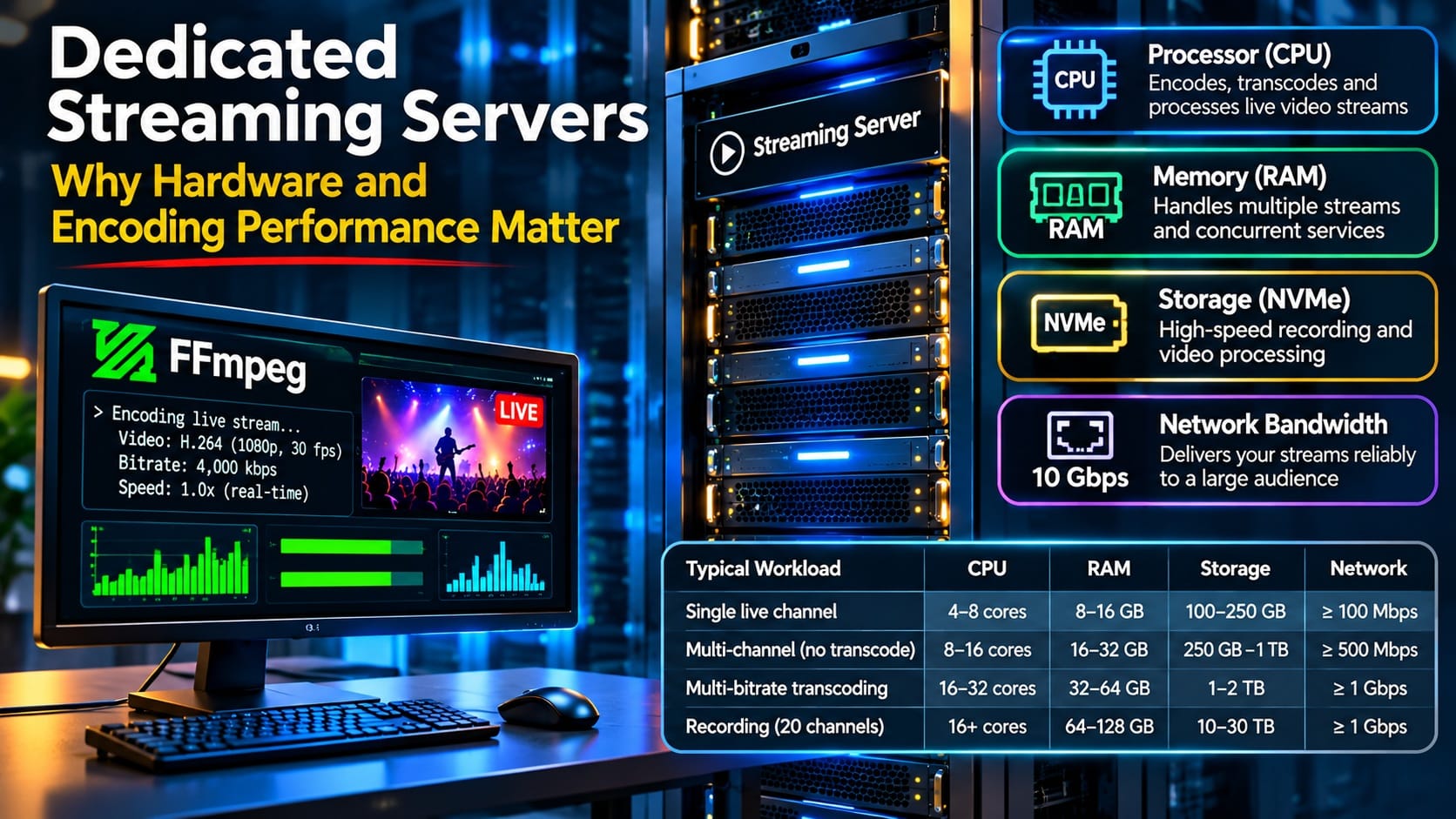
Hardware becomes particularly important when a server must transcode multiple video streams, process large amounts of traffic or perform recording operations.
But if the primary bottleneck is excessive buffering, simply adding more CPU cores may have little effect.
We explored the relationship between hardware resources and broadcasting workloads in our related article on FFmpeg hosting and streaming server performance.
The broader lesson is that infrastructure must be evaluated as a complete system.
Five Lessons for Professional Broadcasters
Our experience with this international deployment highlights several practical principles.
1. Measure the original delay before making changes.
Without a starting measurement, it is difficult to determine whether an adjustment has improved performance.
2. Investigate the entire streaming workflow.
The problem may involve the encoder, streaming server, network, CDN or player.
3. Choose server locations strategically.
Geographical placement should reflect where streams originate and where viewers are located.
4. Balance latency against stability.
Reducing buffers too aggressively can produce interruptions or inconsistent playback.
5. Treat streaming infrastructure as an ongoing engineering responsibility.
Software updates, network conditions and audience requirements change over time. Reliable broadcasting requires monitoring and occasional adjustments.
Conclusion: Streaming Performance Depends on Architecture, Not Just Hardware
The improvement from approximately 75 seconds of streaming delay to a customer-reported six seconds demonstrates the value of careful technical optimisation.
The project involved international dedicated infrastructure, streaming delivery improvements and attention to the interaction between software and networking.
The result was not simply the consequence of purchasing faster servers.
It came from examining the complete broadcasting workflow and making changes appropriate to the customer’s requirements.
For organisations operating television channels, entertainment networks or international live streaming services, the lesson is straightforward:
A dedicated streaming server provides the resources, but the architecture and technical configuration determine how effectively those resources are used.
And sometimes, improving the way video travels through a network can make a far greater difference than upgrading the hardware itself.